
How Is Testosterone Produced In Men? ANSWERED
You don’t have to be a rocket scientist (or even a molecular biologist) to understand how is testosterone produced in men? We spell it all out, simply, right here.
You’re exhausted. Brain fog you can’t shake. A libido that’s quietly disappeared. Weight that won’t budge, no matter what you do and you’re pretty sure TRT is in your future.
You’ve Googled your symptoms, maybe even talked to a doctor, and somewhere along the way, someone planted a seed of doubt:
“What about prostate cancer?”
So you sit with the symptoms. You tell yourself it’s just aging. You walk away from TRT before you ever start, because the last thing you need is to trade low energy for a cancer diagnosis.
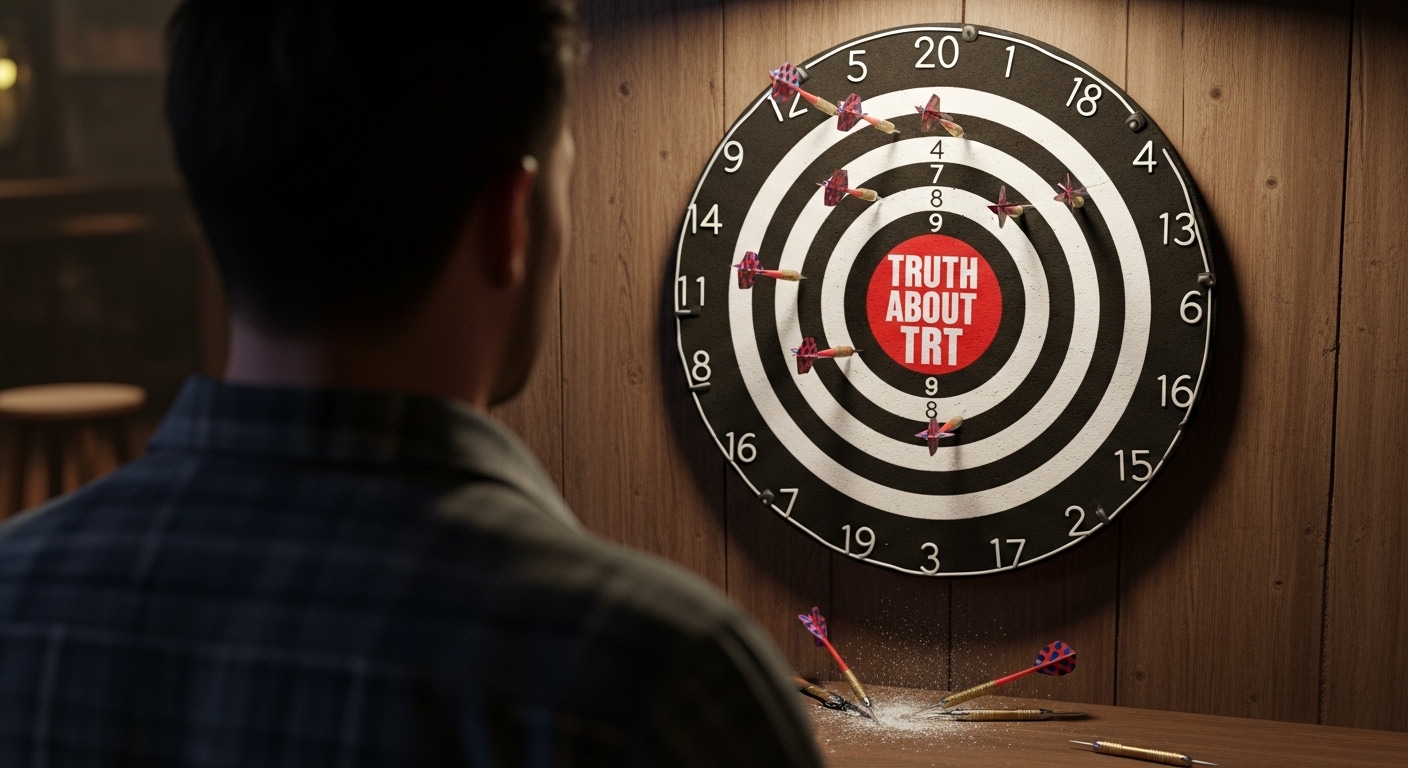
Here’s what nobody told you: that fear is one of the most persistent testosterone myths in medicine. And not just any myth — one traced back to a single case study from 1941.
The science has moved on. Most doctors haven’t.
And as long as testosterone myths keep circulating unchallenged, men keep suffering symptoms they don’t have to live with.
Here’s the scoop:
In 1941, Dr. Charles Huggins published research suggesting that testosterone fueled prostate cancer growth. The finding earned him a Nobel Prize. It also shaped how medicine approached testosterone for the next eight decades.
There’s one problem: his conclusion came from a sample size of one patient.
One.
That’s hardly a clinical study, so for 80 years, men avoided treating low testosterone — and the symptoms that come with it — because of what amounts to a medical old wives’ tale. Doctors repeated it. Medical schools taught it. And patients paid the price.
The testosterone myths born from that single case study calcified into standard practice. Questioning them was considered fringe. Even as better evidence emerged, the institutional inertia kept the fear alive. Patients kept asking whether TRT is safe, and too many physicians answered with a shrug and an outdated warning instead of the actual research.
Dr. Abraham Morgentaler, a Harvard urologist, spent decades building the research that dismantled the Huggins assumption. His Saturation Theory changed the conversation entirely — and put some of the most stubborn testosterone myths to rest.
Here’s the concept in plain language:
Think of your prostate like a sponge. It can only absorb so much testosterone. Once it’s saturated — around 240–250 ng/dL — it can’t take on any more. Adding more testosterone doesn’t make it “wetter.” The rest just pours off.
Morgentaler’s research showed that prostate cancer growth responds to testosterone only at very low levels. Once you cross that saturation threshold, higher testosterone levels don’t accelerate cancer growth. The prostate receptors are already full.
He didn’t stop at theory. In one of his pilot studies, men with biopsy-confirmed prostate cancer were given testosterone therapy and re-biopsied. Half of them came back with normal results. That’s not a footnote — that’s a finding that should have rewritten the textbooks.
His work spans more than 120 peer-reviewed scientific articles. When patients ask whether TRT is safe, this is the body of evidence that answers the question. This isn’t a fringe position anymore. It’s the current evidence base.
Here’s where the testosterone myths flip entirely — and where most men’s doctors have left them in the dark.
Low testosterone may actually increase your risk of prostate cancer.

Morgentaler biopsied 345 men with no symptoms and normal PSA levels, all with testosterone at or below 300 ng/dL. Among men with a PSA of 1.0 or below, the cancer detection rate was 5.6%. By the time PSA crept toward 4.0 — still within what most doctors consider “normal” — the detection rate had climbed to 36.4%. The gradient is hard to ignore.
These weren’t men with warning signs. They were considered healthy. The one thing they had in common was low T.
The research conclusion was direct: more severe reductions in testosterone correlated with higher prostate cancer risk. It’s one of the most important testosterone myths to unpack, because the fear is running exactly backwards. If your doctor is leaving your low testosterone untreated out of cancer concern, the data suggests they may be doing the opposite of protecting you.
Bringing your testosterone back to a healthy range isn’t just about energy, libido, or body composition — though those matter. It’s about the kind of biological balance that supports long-term health. Testosterone isn’t the villain here. Deficiency might be.
Most physicians were trained on textbooks that haven’t caught up to the last 20 years of research. When testosterone myths go uncorrected at the medical school level, patients end up walking away from treatment that could genuinely help them — based on fear the evidence doesn’t support.
The TRAVERSE Trial — a large, prospective cardiovascular and safety trial — found no significant increase in prostate cancer incidence among men treated with testosterone replacement. The European Urology Journal published Morgentaler’s own review in 2006 with a conclusion that has only been reinforced since: there has never been a scientific basis for the belief that testosterone causes prostate cancer to grow.
The FDA still carries a warning on testosterone labels about prostate cancer risk. That warning is actively being petitioned for removal. The research has outpaced the regulation.
At Peak Performance Medical Center near Tampa, we don’t rely on outdated assumptions to manage your care. We test. We track your PSA, your testosterone levels, your biomarkers — and we monitor you consistently, not just at the first appointment and never again. If your labs tell a story, we read it.
Is TRT safe for you specifically? That’s a question worth answering with your actual numbers — not with false evidence appearing real (F.E.A.R).
You don’t have to be a rocket scientist (or even a molecular biologist) to understand how is testosterone produced in men? We spell it all out, simply, right here.

Testosterone boosting meals don’t have to be lame or complicated. In this series, we’re helping guys make mealtime easy with breakfast, lunch, dinner, and snack call outs. Less thinking. More eating. More testosterone.

If you’re holding off on TRT treatment because a little bird told you that it causes prostate cancer, you might be shocked about what you learn in this myth-busting series.

You kick off your weight-loss plan with passion and dedication. You start to measure results. THEN, Murphy’s law takes over. The wieght-loss stops. You double-down your efforts. And nothing happens. HERE’S WHAT’S REALLY GOING ON…

You DON’T have to suffer in silence. Most men do. But you’re not like most men. This article will walk you through all the options on the path to successful ED treatment.

Exhaustion, weight loss issues, anxiety, depression, and so many more wellness issues point to the thyroid glad. Do any of these issues sound like you?